Azure SQL Database — Service Reference
Service Architecture
Azure SQL Database — Service Architecture
Logical Server
Administrative container for databases. Firewall rules, Entra admin, auditing configured here.
Single Database
Isolated database with dedicated resources (DTU or vCore). Independent scaling.
Elastic Pool
Multiple databases sharing a pool of resources. Cost-effective for spiky multi-tenant workloads.
Service Tiers — Architecture Comparison
General Purpose
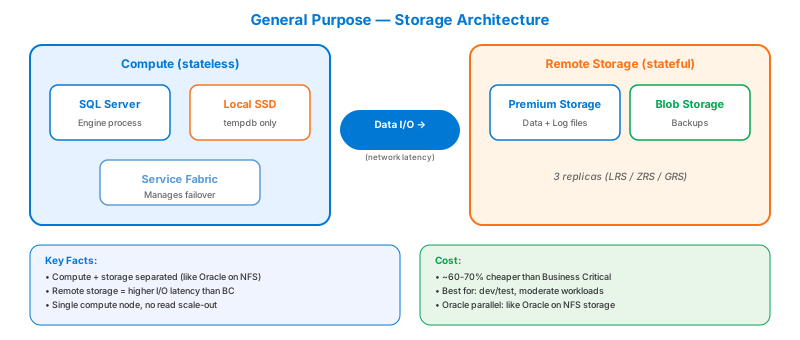
General Purpose Architecture
Compute Node
Stateless SQL engine process. On failure, new node provisioned from standby pool.
Remote Storage
Azure Premium Storage. Data files stored remotely. ~5-10ms latency.
Failover ~30s
New compute attaches to existing storage. No data loss. Applications need retry logic.
| Aspect | Detail |
|---|---|
| Storage | Remote Azure Premium Storage |
| IOPS | ~500-7,500 (storage-dependent) |
| Latency | ~5-10ms |
| Failover | ~30 seconds (new node attaches remote storage) |
| Read replicas | ❌ |
| Zone redundancy | ✅ (optional) |
| Best for | Most workloads, cost-sensitive apps |
Business Critical
Business Critical
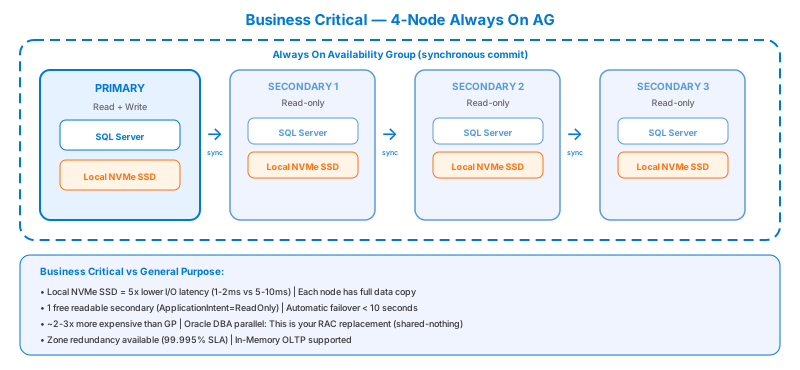
Business Critical Architecture
4-Node Always On AG
1 primary + 3 secondaries. Synchronous commit. All nodes have local SSD copies.
Local NVMe SSD
~1-2ms latency, 30K-400K+ IOPS. Data is local on each replica for fast failover.
1 Free Read Replica
Use ApplicationIntent=ReadOnly to route reads to secondary. Offload BI/reporting.
| Aspect | Detail |
|---|---|
| Storage | Local NVMe SSD on each replica |
| IOPS | ~30,000-400,000+ |
| Latency | ~1-2ms |
| Failover | ~5-10 seconds (data already on secondary) |
| Read replicas | ✅ 1 free (use ApplicationIntent=ReadOnly) |
| Zone redundancy | ✅ (optional) |
| In-Memory OLTP | ✅ |
| Best for | Mission-critical OLTP, low-latency |
Hyperscale
Hyperscale Architecture
Page Servers
Distributed storage layer. Each caches a portion of the DB. Up to 100 TB total.
Log Service
Central write-ahead log. Distributes records to page servers and compute replicas.
Snapshot Backups
Near-instant regardless of DB size. Fast restore in minutes. Reverse migration to GP (up to 1 TB).
| Aspect | Detail |
|---|---|
| Max size | 100 TB |
| Backup | Near-instant (snapshot-based) |
| HA replicas | Up to 4 |
| Named replicas | Up to 30 (independent compute scale) |
| Reverse migration | ✅ Back to GP (up to 1 TB) |
| Best for | Very large databases, elastic read scale |
🎯 Exam Focus
Hyperscale facts: Only tier > 4 TB. Snapshot-based backups = near-instant. Named replicas can have different compute sizes (great for isolating reporting workloads). Can reverse-migrate to GP if ≤ 1 TB.
SLA Comparison
| Configuration | SLA |
|---|---|
| General Purpose (single zone) | 99.99% |
| Business Critical (single zone) | 99.99% |
| Business Critical (zone redundant) | 99.995% |
| Hyperscale (2+ HA replicas, zone redundant) | 99.995% |
Key Limits to Remember
| Limit | Value |
|---|---|
| Max databases per logical server | 5,000 |
| Max databases per elastic pool | 500 |
| Max vCores (single DB) | 128 |
| Max tempdb size (GP) | Depends on local SSD cache |
| Max concurrent sessions (GP 2 vCores) | 200 |
| Max concurrent workers (GP 2 vCores) | 200 |
What are the 3 service tiers for Azure SQL Database (vCore)?
Click to reveal answer
General Purpose (remote storage, balanced), Business Critical (local SSD, 4 replicas, read scale), Hyperscale (100 TB, page servers, named replicas).
1 / 6